Do you know what is happening in your production at this very moment? Who is working on which order? Which machine is currently idle? Where exactly is the bottleneck? Most companies think they know. But they don’t.

Management via the rearview mirror
In production, decisions are still frequently made based on data that is no longer valid. An operator writes performance figures on paper. At the end of the shift, “it” gets transcribed into the system. The next morning, you have a report (more or less distorted). But what you are looking at is the past.
Meanwhile:
- A machine stood idle for half an hour.
- Workers were waiting for material.
- An order fell behind schedule.
And no one reacted. Not because they didn’t want to—but because they didn’t know.
The Illusion of oversight
“But we have reports. We can see how we’re doing.”
Yes. But when?
In many companies, you only learn key information after the fact. At a meeting. Or once a problem escalates.
But that isn’t production management anymore. That is a post-mortem evaluation of what went right and what went wrong.
What It truly costs you
These losses aren’t visible at first glance. They don’t appear as a single line item in your accounting. But they are everywhere:
- Downtime (unaddressed in real-time, waiting between operations, emergency incidents).
- Poor quality (timely intervention can prevent significant losses).
- Inefficiency (every small increase in efficiency equals money).
- Misaligned Priorities.
- Chaos on the shop floor.
A typical example from the field:
One company recorded downtime manually. Inaccurately. With a delay.
As a result, they didn’t actually know:
- How much downtime they had.
- Why it was happening.
- Where to fix it.
It was only when they began collecting downtime data automatically in real-time using a MES (Manufacturing Execution System)—including downtime type detection—that they saw where the production was truly losing time and why.
Most importantly, they could finally react immediately.
Data no one trusts
Another problem: the data exists, but no one trusts it.
Operators record performance manually. Sometimes they “help” the numbers. Sometimes they log them retroactively. Reports are often generated manually.
The result? The reports look good. The reality, less so.
In one company, workers were even “hiding” completed work to report it the next day. This made their performance look more consistent than it actually was.
Managing production based on such data is an illusion.
The most expensive moment: when you finally see the truth
An interesting thing happens when you implement a MES and start collecting and evaluating data correctly.
Suddenly:
- OEE drops (it is now correctly calculated based on accurate data).
- Performance looks worse.
- The numbers “don’t add up.”
This isn’t because production got worse. It’s because you are seeing it as it truly is for the first time.
This is the moment of truth. You either accept it and start managing production better, or you go back to the “pretty” numbers.
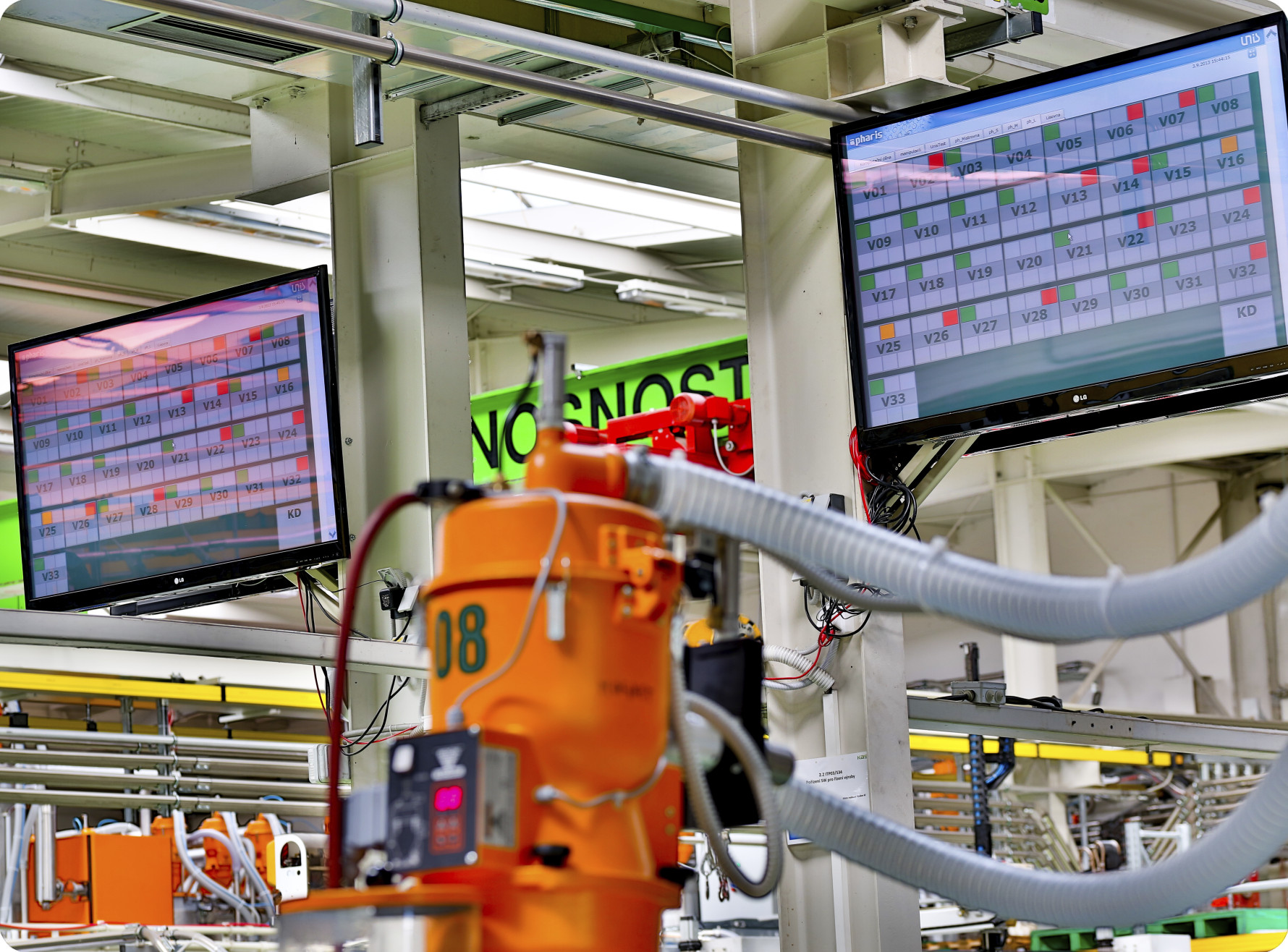
What real-time production management means
Managing production in real-time isn’t about having more reports. It’s about:
- Seeing what is happening right now.
- Knowing exactly where a problem is originating.
- Reacting immediately (automated processes, workflows).
You don’t wait for the end of the shift or for the problem to show up in the final results. You solve things as they arise—before they impact the entire production flow. Every minute has a price, and every delay has an impact that you can never recover retroactively.
Real-time management means having simple workflows built on top of online data. Once specific conditions are met, the system automatically triggers an action (from notifications and calling maintenance to alarms or even stopping the machine).
It’s not magic; it’s just utilizing available technology. Yet, it represents a fundamental shift across the entire manufacturing process. In this context, a MES is a tool for monitoring production and automatically influencing it based on its current state.
For example:
- Downtime isn’t evaluated retrospectively; it’s addressed now.
- An order is nearing completion—start preparation for the next one in advance.
- You are currently producing more scrap than expected—change it now.
- OEE on a running job is suspiciously low—find out what’s happening.
The result?
Less chaos. Faster, automated decision-making. Higher efficiency.
And often, a surprisingly fast ROI—in some cases, within a matter of months.
A simple closing question
Knowing what happened yesterday is not enough. Do you know what is happening in your production right now?
Because if you don’t, you aren’t managing production. You are just reacting to it.
Tomáš Hradský
CEO, PHARIS